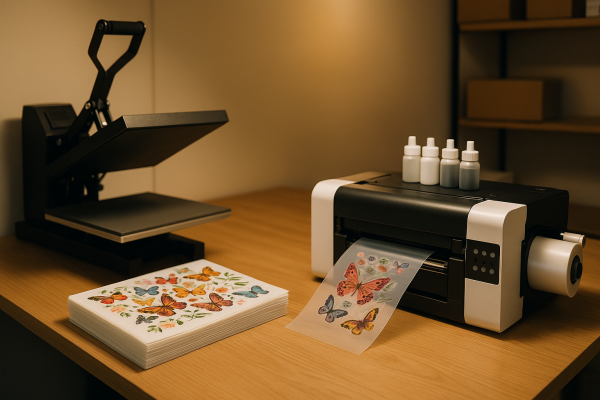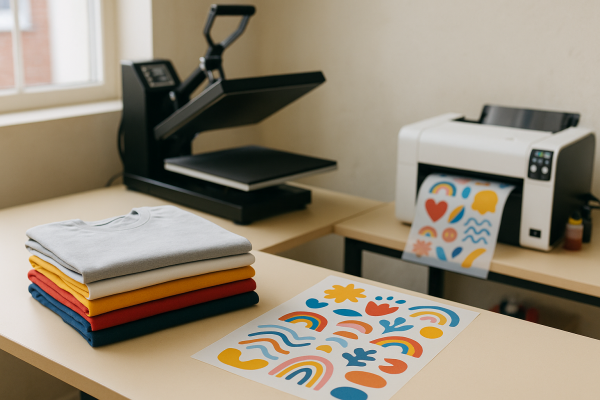
If you've spent any time on supplier websites lately, you've probably noticed the word "eco-friendly" stamped on just about every bottle of ink and roll of film. It's a good instinct — customers care, and so do most shop owners — but the reality of sustainable DTF printing is messier than the labels imply. The good news is that real progress is happening on inks, films, powders, and the way we run our shops. Let's walk through what's genuinely greener, what's just marketing, and where you can make practical changes without blowing up your workflow.
Why DTF Has a Sustainability Story Worth Telling
Compared to plastisol screen printing, DTF already has a few things going for it. The inks are water-based pigment formulations rather than PVC and phthalate-heavy plastisols. There's no screen reclaim chemistry, no emulsion stripper running down the drain, and no dunk tank of solvents. You print on demand, which means fewer overstocked shirts headed to a landfill.
That said, DTF isn't a clean process by default. The film is plastic. The adhesive powder is a thermoplastic polymer (typically a polyurethane or copolyamide). The transfers themselves leave a polymer layer on the garment, which affects how that shirt biodegrades at the end of its life. So when we talk about "sustainable DTF," we're really talking about reducing harm at every step — not pretending the process is carbon-neutral.
What's Actually in Your Ink
Most DTF inks share a similar backbone: water as the carrier, pigment dispersions for color, glycols and glycol ethers as humectants, surfactants, biocides, and a binder resin. The "eco" claims usually focus on a few specific things:
- OEKO-TEX ECO PASSPORT certification — This is the most meaningful third-party mark you'll see on DTF inks. It tests the ink for restricted substances and is a real benchmark, not a self-issued sticker. If your customers sell to baby brands or to retailers like big-box stores, this certification often becomes a purchase requirement.
- Low-VOC formulations — Water-based pigment inks are inherently lower in volatile organic compounds than solvent inks, but some brands push further by reducing glycol ether content. Your nose and your shop's air quality will thank you.
- APEO-free and formaldehyde-free — Alkylphenol ethoxylates and formaldehyde-releasing biocides have been phased out by most reputable ink makers. Worth confirming on the SDS rather than trusting marketing copy.
One honest caveat: the pigments themselves are still industrial chemicals, and the carbon black in your K channel isn't going to be made from recycled coffee grounds anytime soon. "Eco-friendly ink" is a relative term. Look for documented certifications, a current SDS, and a manufacturer willing to answer technical questions.
The Film Problem — and What Some Brands Are Doing About It
PET film is the elephant in the room. It's petroleum-based plastic, and most operators throw the carrier sheet straight in the trash after pressing. A busy shop can easily go through several rolls a week, and that adds up.
A few directions are worth watching:
- Recycled PET (rPET) films — A handful of suppliers now offer films with a percentage of post-consumer recycled content. Print quality has gotten close to virgin PET, though some operators report slightly more variation in coating consistency. Worth a sample roll before committing.
- Thinner gauge films — Going from 100-micron to 75-micron film cuts plastic use by 25% per square meter. Many shops have made this switch already for cost reasons; the environmental benefit is a nice bonus.
- Recycling programs — Used PET carrier sheets are technically recyclable, but contamination from ink and powder residue means your curbside bin probably won't take them. A few film suppliers have started take-back programs. They're regional and limited, but the model is promising.
- Compostable or bio-based films — These exist mostly in marketing decks at this point. Real-world performance under heat press conditions has been inconsistent. Hopeful, but not yet shop-ready for most workflows.
Adhesive Powders and Their Quiet Footprint
Powder doesn't get talked about much in sustainability conversations, but it should. The two common chemistries — TPU (thermoplastic polyurethane) and copolyamide — are both petroleum-derived plastics that end up bonded to the garment forever.
What you can do today:
- Use the right amount. Over-powdering is incredibly common and wasteful. A properly powdered transfer has just enough adhesive to coat the printed areas, with the excess shaken cleanly off. If you're seeing a halo around your designs, you're using too much.
- Capture and reuse overflow. A good powder shaker recirculates excess powder back into the hopper. If you're hand-powdering, work over a clean tray and funnel the unused powder back into the bag.
- Ask about low-melt powders. Powders that cure at lower temperatures (around 110–120°C versus 160°C+) reduce the energy your oven or press uses across thousands of transfers. The savings are real over a year of production.
Energy, Waste, and the Shop Itself
Inks and films get the headlines, but the biggest sustainability wins in most DTF shops are operational. Here's where to look:
- Curing ovens. A conveyor oven running all day pulls serious wattage. Insulate where you can, keep the curtains in good shape, and shut it down during long lulls rather than idling.
- Heat press habits. Modern auto-open presses with good insulation use noticeably less energy than older swing-aways left on all day. If your press is over a decade old, an upgrade pays back in both power and productivity.
- Print-on-demand workflow. One of DTF's real environmental advantages is that you can produce gang sheets to order. Avoid speculative inventory — print what's sold.
- Waste ink and cleaning fluid. Don't pour these down the drain. Most municipalities classify them as industrial waste. A licensed waste hauler is the right answer, even for small shops.
- Packaging. Paper mailers, recycled poly bags, and right-sized boxes are easy swaps that customers actually notice.
Talking to Customers Without Greenwashing
If sustainability matters to your brand, be specific. "Eco-friendly" by itself means nothing to a savvy buyer. What works better:
"We print with OEKO-TEX ECO PASSPORT certified water-based inks, use 30% recycled PET film, and produce every transfer to order — no warehouse of unsold shirts."
That's a sentence you can defend. It also gives customers something concrete to pass along to their customers, which is the whole point.
A Realistic Starting Checklist
You don't need to overhaul the shop tomorrow. Pick a few of these and start:
- Confirm your ink has a current ECO PASSPORT or equivalent certification, and file the SDS.
- Request a sample of recycled-content film from your supplier and test it against your current roll.
- Audit your powder use for one week — weigh in, weigh out, calculate waste.
- Set your curing oven on a timer or shutdown schedule.
- Switch to recycled or paper-based shipping mailers.
- Find a licensed hauler for waste ink and document your disposal.
Sustainable DTF printing isn't a destination — it's a direction. The technology is improving year over year, and the shops that pay attention now will be the ones with the easiest answers when a big customer eventually asks the hard questions. Start with what's practical, be honest about what isn't, and keep an eye on the suppliers actually doing the work.