If you're selling custom apparel, sooner or later you'll hit the same fork in the road every print shop reaches: do you keep ordering DTF transfers from a supplier and pressing them yourself, or do you bring the whole printing process in-house? Both paths can work beautifully. Both can also turn into expensive mistakes if you pick the wrong one for your stage of business. Let's walk through how to decide.
The Two Approaches, in Plain English
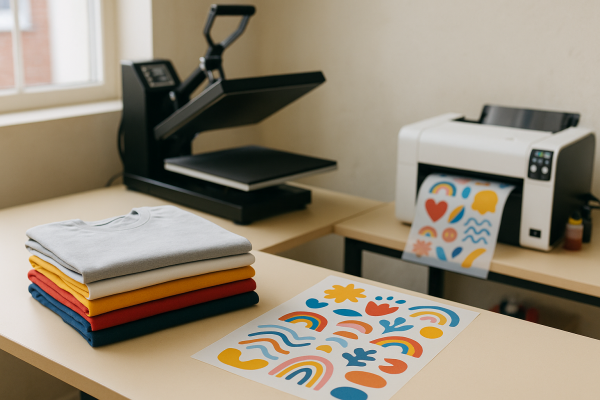
With ordered DTF transfers, you upload your artwork to a print-on-demand transfer supplier (sometimes called a gang sheet provider). They print, powder, and cure the film, then ship you a finished transfer that's ready to heat-press onto a garment. Your equipment list is short: a heat press, a flat surface, and maybe a Teflon sheet.
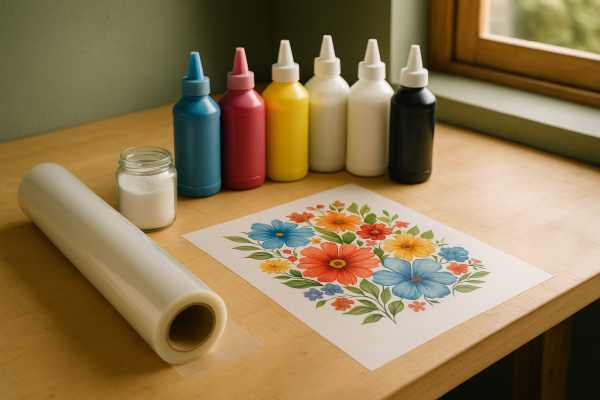
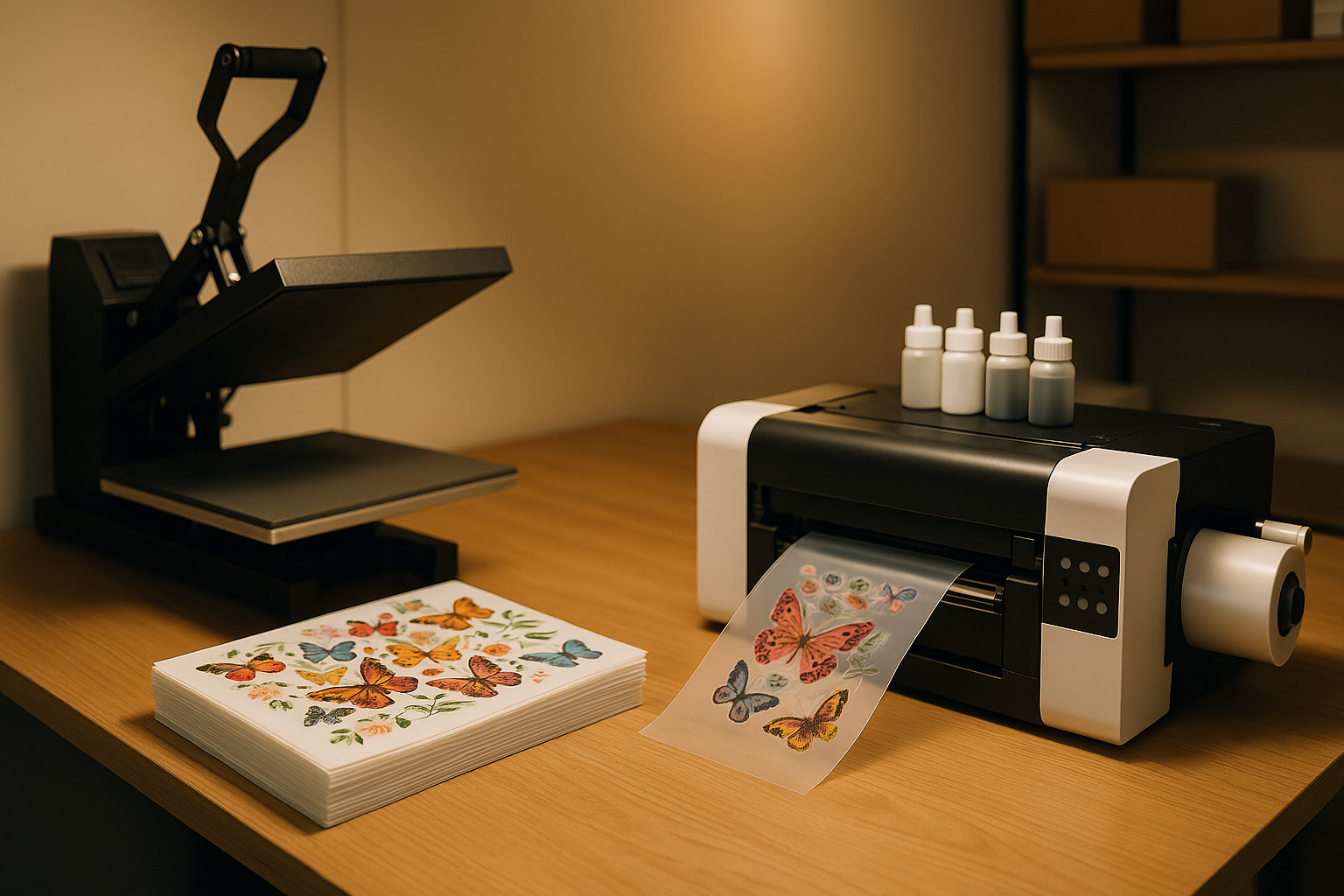
With in-house DTF printing, you own the whole pipeline. That typically means a DTF printer (modified Epson or a purpose-built unit), white and CMYK pigment inks, PET film, adhesive powder, a curing oven or shaker, RIP software, and the heat press at the end. You print, powder, cure, and press — all under your own roof.
Neither approach is inherently "better." They're just suited to different volumes, cash positions, and tolerance for technical hassle.
The Real Cost Comparison
Let's talk numbers — with the caveat that prices shift constantly, so treat these as ballpark figures rather than quotes.
Buying Transfers
- Upfront cost: Effectively just your heat press (a decent 16x20 clamshell runs $300–$1,500).
- Per-transfer cost: Most suppliers price gang sheets by the square inch. A 22"x24" gang sheet often lands between $15 and $25, which works out to roughly $1–$3 per medium-sized design depending on how tightly you nest your art.
- Hidden costs: Shipping, occasional reprints if a sheet arrives damaged, and the 2–7 day wait between ordering and pressing.
Printing In-House
- Upfront cost: A converted Epson L1800 setup might start around $1,500–$3,000. A dedicated A3 DTF printer with a built-in shaker often runs $4,000–$10,000. Larger 24-inch roll-fed systems can climb past $20,000.
- Consumables: Ink, film, and powder typically work out to somewhere in the $0.30–$0.80 range per medium transfer, depending on coverage and how efficiently you nest.
- Hidden costs: Maintenance ink, waste from clogs, electricity for the curing oven, ventilation, and your time.
On paper, in-house looks dramatically cheaper per print — and at high volumes, it is. The catch is that those savings only materialize after you've covered the equipment, learned the process, and kept the printer running reliably.
The Break-Even Math
A simple way to think about it: take your equipment investment and divide it by the per-transfer savings. If a transfer service charges you $2 per design and you can print the same one in-house for $0.60, you're saving about $1.40 per piece. On a $5,000 printer setup, that's roughly 3,500 transfers before you break even on hardware alone — not counting your labor, maintenance, or the inevitable learning-curve waste.
If you're pressing 20 shirts a week, that break-even is years away. If you're pressing 200 a week, you'll get there in a few months.
When Ordering Transfers Makes More Sense
- You're under about 50–100 transfers a week. The math just doesn't favor owning a printer yet.
- You're testing designs or a new brand. Why tie up capital before you know what sells?
- You don't have a dedicated workspace. DTF printers need a temperature- and humidity-controlled room, ventilation for the powder and curing, and somewhere you can leave the machine undisturbed.
- You hate troubleshooting. Clogged print heads, white ink settling, RIP profile tweaking — if any of that sounds miserable, outsourcing the printing keeps your stress low.
- Your orders are unpredictable. A printer left idle for a week can develop clogs that take hours to clear. Transfer suppliers handle that for you.
When In-House Printing Pays Off
- You're consistently pressing 100+ transfers a week. The per-piece savings start adding up fast.
- You need quick turnaround. Rush orders, last-minute corporate jobs, and "can you do this by tomorrow?" customers become a competitive advantage when you're not waiting on shipping.
- You're doing one-offs and personalization. Printing a single name or photo on demand is painful through a supplier — minimum gang sheet sizes mean you waste film.
- You want creative control. Color matching, special effects like puff additives, and tweaking white underbase density are all easier when you own the workflow.
- You want to sell transfers yourself. Becoming the supplier for other small shops is a legitimate business model.
The Hybrid Approach Nobody Talks About Enough
Plenty of successful shops do both. They run an in-house printer for their bread-and-butter daily work and order from a transfer supplier when:
- A huge order comes in that would tie up the printer for two days.
- Their machine is down for maintenance.
- A customer wants a specialty effect (neon, reflective, glow) they don't stock inks for.
- They're traveling to a market or pop-up and need pre-printed inventory.
Treating outsourced transfers as a flex capacity tool, rather than an all-or-nothing choice, is one of the smarter moves you can make once your shop matures.
Quality: Is There a Real Difference?
Honestly, it depends entirely on the supplier and on your own setup. A reputable gang sheet provider running good inks and properly cured powder will produce transfers that are indistinguishable from a well-tuned in-house print. A bargain-bin supplier cutting corners on powder or undercuring will produce transfers that crack after a few washes.
Same goes for in-house. A clean, well-maintained printer with quality consumables can outperform anything you'd order. A neglected one with cheap ink will embarrass you.
The honest takeaway: quality is about process discipline, not about who owns the printer.
A Quick Decision Checklist
- How many transfers do you press in a typical week, honestly?
- Do you have $3,000–$10,000 in capital you can deploy without straining the business?
- Do you have a clean, climate-controlled room with ventilation?
- Are you comfortable doing weekly nozzle checks, capping station cleanings, and ink agitation?
- Is fast turnaround a meaningful selling point for your customers?
- Do you do a lot of single-piece personalization?
If you answered "low volume," "no," or "not really" to most of those, keep ordering transfers. If you answered "high volume," "yes," and "absolutely," it's probably time to bring printing in-house.
Final Thought
The shops that struggle most are the ones who buy a printer because it feels like the "real" next step, then discover they don't have the volume to justify the maintenance routine. The shops that thrive treat the buy-versus-print decision as a math problem, not an ego problem. Run your numbers, be honest about your workflow, and pick the path that matches where your business actually is — not where you wish it was.